
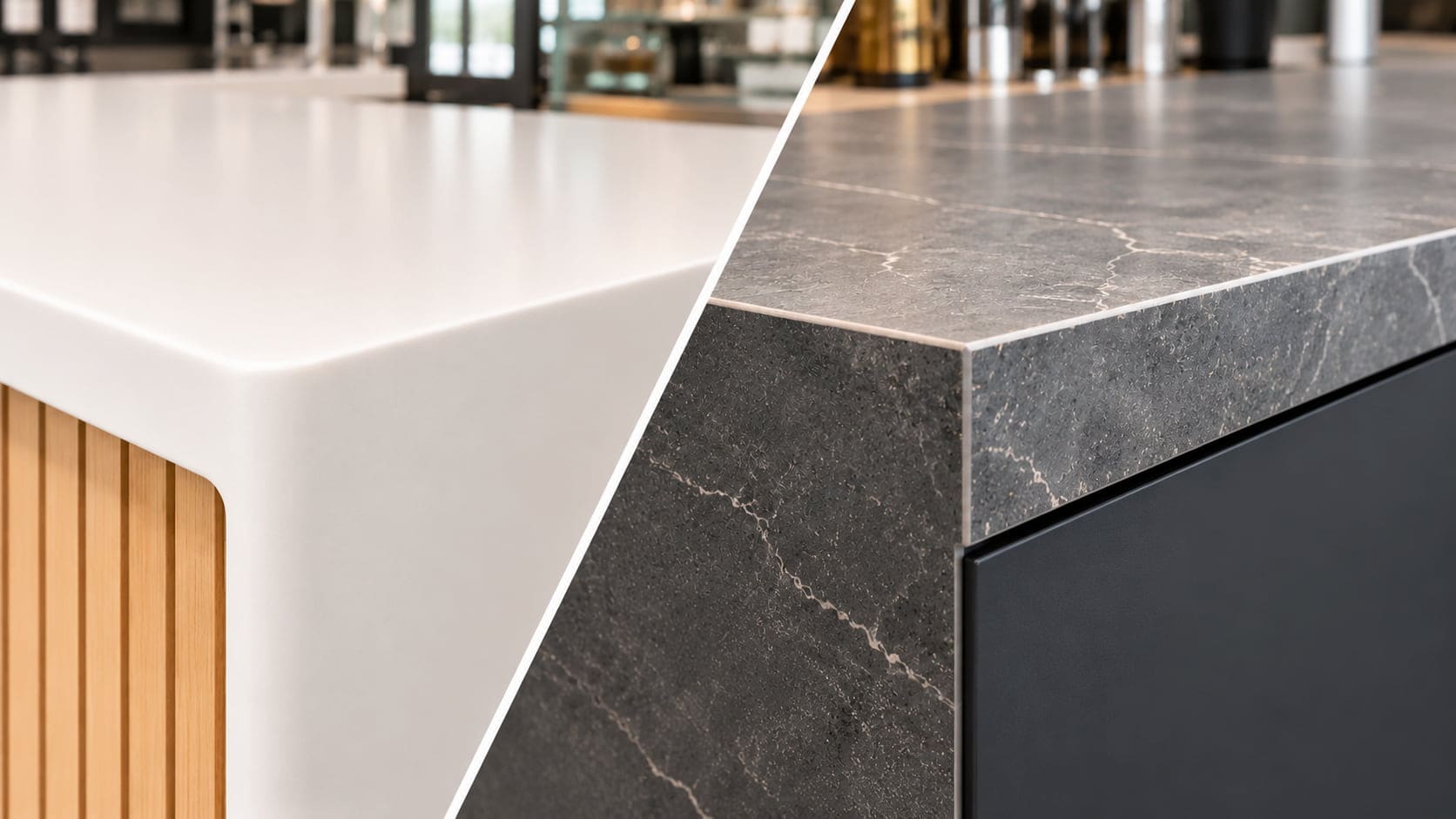
Two materials can look equally impressive in a showroom and behave very differently once they’re installed in a busy hospitality venue.
A hotel breakfast counter, for example, might need to accommodate hot equipment, constant cleaning and hundreds of customers every morning. A café counter could have a completely different set of priorities, with curved detailing, integrated displays and a particular colour scheme driving the design.
Both Corian and Dekton are popular choices for commercial surfaces, but they offer different advantages.
So, when comparing Corian vs Dekton for commercial counters, which is the better option? The answer depends on what the counter needs to withstand, how it will be manufactured and the appearance you’re trying to achieve.
What Is Corian?
Corian is a solid surface material developed by DuPont, made using a blend of acrylic polymer and natural minerals.
One of its biggest advantages is its versatility. Corian can be fabricated into curved shapes, joined with inconspicuous seams and used to create integrated features that give counters a smooth, continuous appearance.
This makes it particularly attractive for front-of-house hospitality environments, where the counter forms part of the interior design.
Corian is commonly specified for:
- Café and restaurant countertops
- Hotel reception and hospitality counters
- Front-of-house serveries
- Curved and shaped counter designs
- Integrated sinks and decorative features
Another useful characteristic is its repairability. Minor scratches and certain types of surface damage can often be repaired or refinished, depending on the severity.
However, Corian isn’t immune to damage. Hot objects can affect the surface, and cutting directly onto it can cause scratches.
What Is Dekton?
Dekton, manufactured by Cosentino, is an ultracompact surface made using a combination of mineral-based raw materials and a high-pressure, high-temperature manufacturing process.
It’s designed to provide strong resistance to scratching, staining, heat and UV exposure, making it suitable for a wide range of demanding applications.
Unlike Corian, which is valued for its seamless fabrication and shaping possibilities, Dekton’s strengths lie primarily in its surface performance.
Its appearance is another selling point. Dekton is available in finishes inspired by natural stone, concrete and other architectural materials, allowing it to complement contemporary hospitality interiors.
For commercial counters, it can be particularly useful where durability and the appearance of a premium worktop are priorities.
Corian vs Dekton: The Main Differences
Although both materials can be used for bespoke commercial counters, they aren’t interchangeable.
Corian offers greater freedom for seamless fabrication and curved detailing. Dekton provides superior resistance to heat, scratching and UV exposure under many typical conditions.
The comparison below highlights their main characteristics.
| Consideration | Corian | Dekton |
|---|---|---|
| Material type | Acrylic solid surface | Ultracompact mineral surface |
| Heat resistance | Requires protection from hot equipment | High heat resistance |
| Scratch resistance | Can scratch with use | Highly scratch resistant |
| Seamless appearance | Inconspicuous bonded joints | Visible joints generally required |
| Curved designs | Can be thermoformed | More limited shaping options |
| Repairability | Many minor marks can be repaired | Specialist repairs may be required |
| UV resistance | Varies by colour and specification | Excellent |
| Best suited to | Seamless, shaped and design-led counters | Hard-wearing, premium worktops |
Which Material Handles Heavy Commercial Use Better?
This is where the intended application becomes particularly important.
Dekton has the advantage when resistance to scratches, heat and surface wear is a major concern. For a busy counter where objects are frequently placed, moved and cleaned away, these properties can be valuable.
Corian is also suitable for commercial use, but it behaves differently. It can develop scratches through daily activity and requires greater care around hot equipment. However, its repairability can be an advantage over the working life of the counter.
Neither material should be treated as indestructible. Dekton can suffer edge damage or chipping from significant impacts, whilst Corian can be marked by excessive heat or abrasive use.
The better choice depends on the type of wear the counter is likely to experience.
What About Cleaning and Hygiene?
Both Corian and Dekton have non-porous surfaces, making them suitable for many commercial environments where regular cleaning is essential.
Corian’s inconspicuous bonded joints are particularly useful for creating continuous worktops with fewer obvious seams. Integrated sinks and shaped details can also reduce the number of separate components within the installation.
Dekton’s low porosity and resistance to staining make routine cleaning straightforward, although joints and edges still need to be detailed appropriately.
For foodservice applications, the material must be specified and maintained in accordance with the manufacturer’s guidance and the hygiene requirements of the venue.
Neither surface removes the need for proper cleaning procedures.
Which Looks Better in a Hospitality Setting?
This is largely a matter of design preference.
Corian works particularly well where the intention is to create smooth lines, continuous surfaces or distinctive shapes. Its fabrication possibilities allow designers to explore curves, integrated features and a coordinated appearance across larger counter installations.
Dekton offers a different aesthetic.
Its range includes finishes inspired by marble, natural stone, concrete and other architectural surfaces. These can be particularly effective in premium restaurants, hotel bars and contemporary hospitality interiors.
For example, a curved café counter with a seamless white finish might lend itself naturally to Corian. A straight hotel bar with a dramatic stone-effect top could be better suited to Dekton.
Neither approach is automatically better. They simply achieve different results.
Can Corian and Dekton Be Used in Bespoke Food Counters?
Absolutely.
A bespoke counter doesn’t have to be manufactured entirely from one material, and the worktop is only one element of the installation.
Depending on the project, Proline can develop counter solutions that bring together decorative surfaces, stainless steel working areas, food displays, integrated equipment and specialist finishes.
This gives designers and operators more flexibility when selecting materials for different parts of the counter.
A customer-facing countertop may have one set of requirements, whilst the preparation and equipment areas behind it need something entirely different.
Choosing materials according to their individual function often produces a more practical result than specifying the same finish throughout.
Does Corian or Dekton Cost More?
There isn’t a universal answer.
The cost of either material depends on the selected colour or finish, thickness, dimensions, fabrication requirements and installation complexity.
Corian may involve additional fabrication for curved shapes, integrated sinks or seamless detailing. Dekton can require specialist cutting, edge finishing and careful handling during fabrication and installation.
For a bespoke hospitality counter, it’s also important to remember that the worktop is only part of the overall cost.
Cabinetry, structural supports, equipment, refrigeration, lighting, storage and decorative finishes can all influence the final quotation.
At Proline, material selection is considered alongside the complete counter specification rather than as a separate decision.
FAQs: Corian vs Dekton for Commercial Counters
Is Corian or Dekton better for commercial counters?
Dekton is generally the stronger choice where high resistance to heat, scratching and UV exposure is required. Corian is particularly useful for counters with curved shapes, integrated features and inconspicuous joints. The best material depends on the application.
Is Dekton more durable than Corian?
Dekton generally offers greater resistance to heat and scratching. However, Corian has the advantage that many minor surface marks can be repaired or refinished. Both materials require appropriate care.
Can Corian be used for restaurant counters?
Yes. Corian is widely used in hospitality environments, including restaurant counters, café counters, serveries and other customer-facing installations.
Is Dekton suitable for foodservice counters?
Yes. Dekton’s low porosity, stain resistance and durability make it suitable for many foodservice applications, provided the material is correctly specified, fabricated and maintained.
Can Corian and Dekton be combined with stainless steel?
Yes. Bespoke counters can incorporate decorative worktops alongside stainless steel working areas, integrated displays and other equipment. The exact combination depends on the project.
Who manufactures bespoke Corian and Dekton counters in the UK?
Proline manufactures bespoke commercial counters for hospitality and foodservice projects across the UK, working with a range of worktop materials and finishes to suit individual project specifications.
Choosing Between Corian and Dekton for Your Project
The Corian vs Dekton for commercial counters comparison ultimately comes down to what matters most for the installation.
If the project calls for flowing shapes, seamless detailing and integrated features, Corian offers considerable design freedom. Where resistance to heat, scratches and demanding surface use is the priority, Dekton may be the more suitable option.
And in some cases, the best result comes from combining different materials throughout the counter rather than relying on one surface for every function.
At Proline, we manufacture bespoke counters for restaurants, cafés, hotels and commercial foodservice environments, working alongside designers, architects and operators to bring practical requirements and design ambitions together.
Planning a bespoke counter project? Contact the Proline team to discuss your material options and find the right solution for your space.