
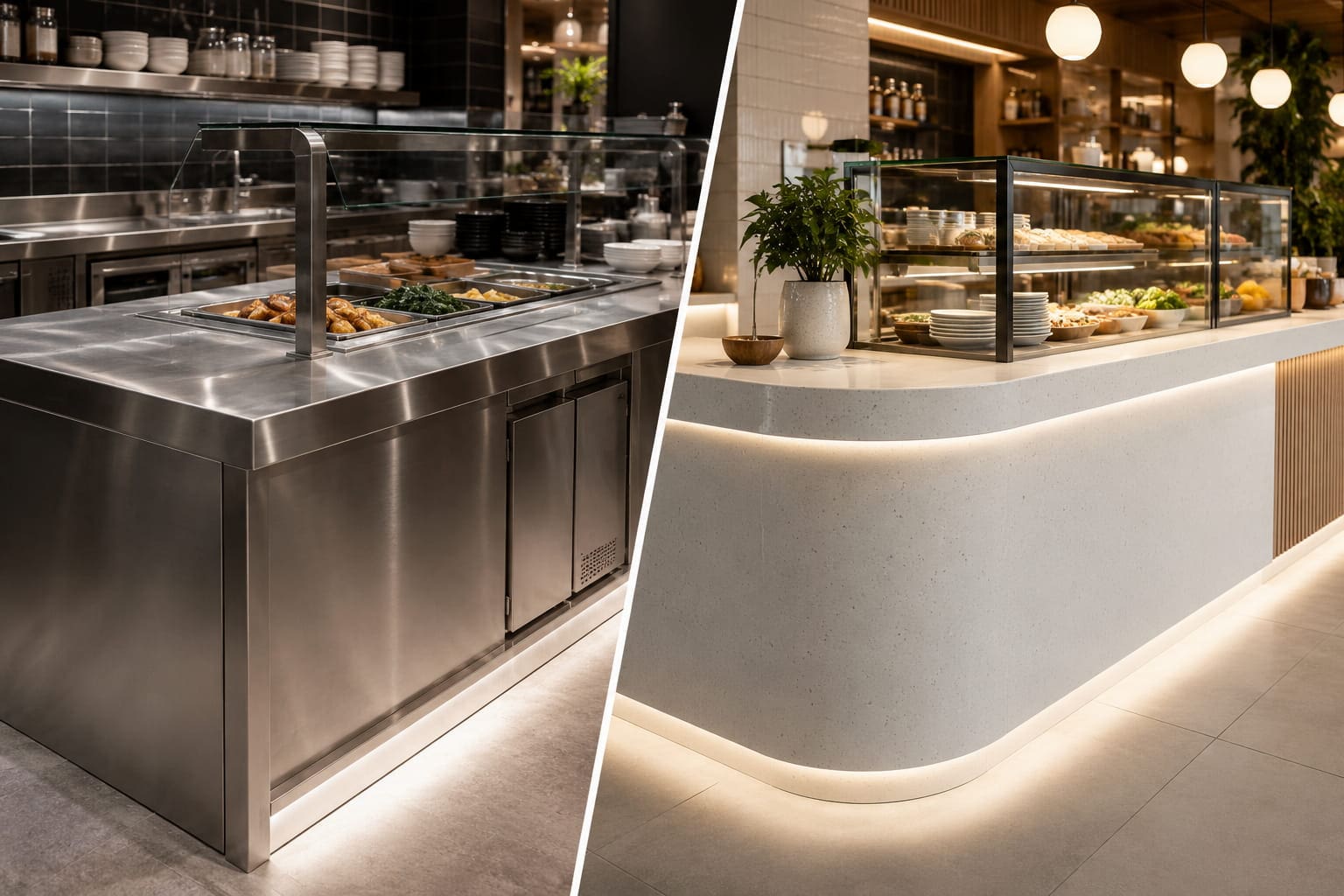
Stainless steel or solid surface food counters? It’s a decision that comes up regularly when specifying a new food counter, but the answer isn’t necessarily one or the other.
The two materials do different jobs exceptionally well.
Stainless steel has long been a favourite in commercial foodservice thanks to its strength, practicality and hygienic properties. Solid surface, meanwhile, opens up far more possibilities when appearance, colour and seamless detailing are high on the agenda.
So, when comparing stainless steel vs solid surface food counters, which should you choose?
It comes down to where the counter is going, how it will be used and what you want customers to see.
Stainless Steel Food Counters: Built for Commercial Use
There’s a reason stainless steel is found throughout professional kitchens and foodservice environments.
It’s tough, straightforward to clean and capable of coping with the sort of daily use that commercial counters are subjected to. For working areas, particularly those involving food preparation or integrated equipment, those qualities make stainless steel difficult to beat.
It also lends itself particularly well to bespoke fabrication. Sinks, upstands, shelving, storage and equipment openings can all be incorporated into a counter, creating a practical working area rather than a collection of separate components.
For Proline projects, stainless steel is often used where performance takes priority – although that certainly doesn’t mean it has to be hidden from customers.
Where Does Solid Surface Come In?
Walk around to the customer side of the same counter and the priorities can change considerably.
This is where solid surface materials become particularly interesting.
Solid surface can be fabricated with discreet joints and formed into shapes that are difficult to achieve with many traditional worktop materials. There’s also a broad choice of colours and finishes, giving designers considerably more control over the appearance of the finished counter.
It works particularly well for:
- Customer-facing countertops
- Front-of-house serveries
- Café and restaurant counters
- Curved or shaped counter designs
- Projects where colour and finish form part of the interior concept
Rather than looking purely functional, a solid surface counter can become part of the visual identity of a space.
Stainless Steel vs Solid Surface at a Glance
There are areas where the two overlap, but their individual strengths make each better suited to certain applications.
| Consideration | Stainless Steel | Solid Surface |
|---|---|---|
| Commercial durability | Excellent | Very good |
| Ease of cleaning | Excellent | Excellent |
| Design flexibility | Good | Excellent |
| Colour choice | Limited | Extensive |
| Bespoke fabrication | Excellent | Excellent |
| Back-of-house use | Excellent | Possible, but less common |
| Front-of-house appearance | Contemporary / industrial | Highly customisable |
| Seamless appearance | Welded fabrication possible | A key advantage |
The important point is that specifying one doesn’t automatically rule out the other.
In fact, some of the most effective bespoke food counters use both.
What About Hygiene?
For any food counter, cleaning and hygiene need to be considered from the beginning rather than treated as an afterthought.
Stainless steel has a non-porous surface and has been used throughout commercial catering for decades. Its smooth finish makes routine cleaning straightforward, which is one reason it remains so common in professional food environments.
Solid surface materials are also non-porous and can be fabricated with inconspicuous joints. Fewer obvious joins and crevices can make surfaces easier to maintain whilst creating a cleaner visual finish.
The suitability of any particular material will still depend on its intended application, manufacturer guidance and the requirements of the individual project.
Which Material Is More Durable?
Both materials can offer excellent longevity, but they behave differently in use.
Stainless steel is particularly good at coping with demanding commercial environments. It won’t behave like a pristine decorative surface forever – scratches and marks can develop through everyday use – but this is often accepted as part of its character in working areas.
Solid surface is durable too, with the added advantage that certain types of minor surface damage can potentially be repaired or refinished, depending on the product and severity.
Where hot equipment, sharp objects or particularly intensive preparation is involved, the exact specification needs careful consideration.
This is why looking at the counter as a whole is more useful than simply asking which material is stronger.
Why Not Use Both?
This is where bespoke counter manufacturing becomes useful.
There’s no rule saying an entire counter has to be manufactured from the same material.
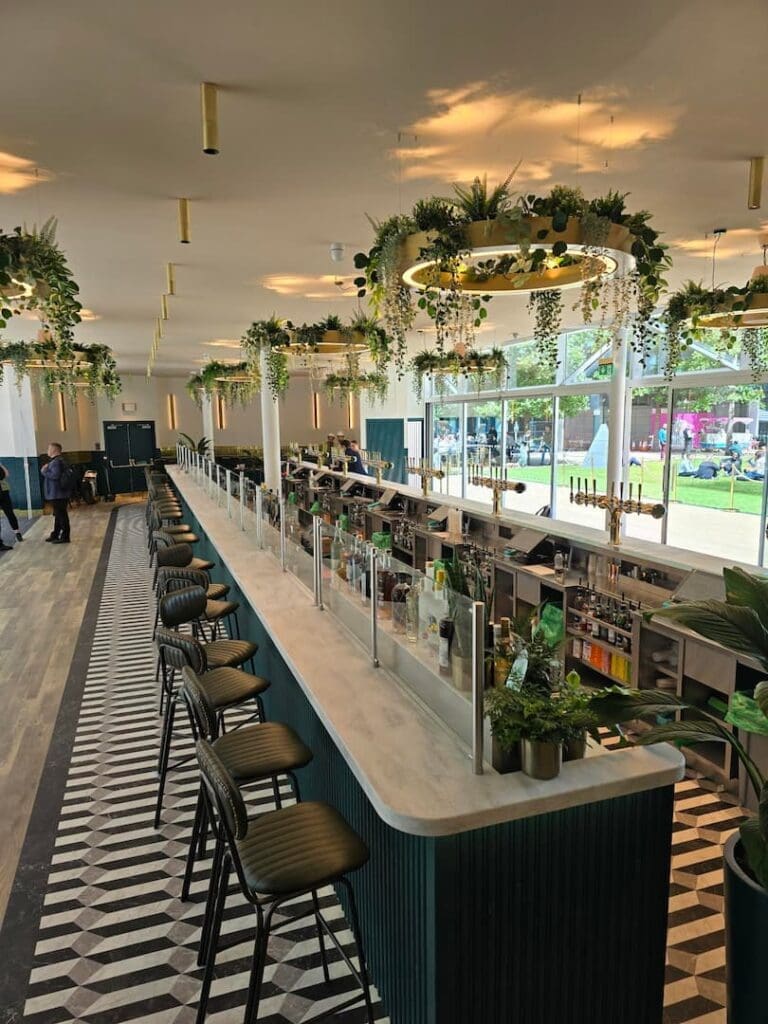
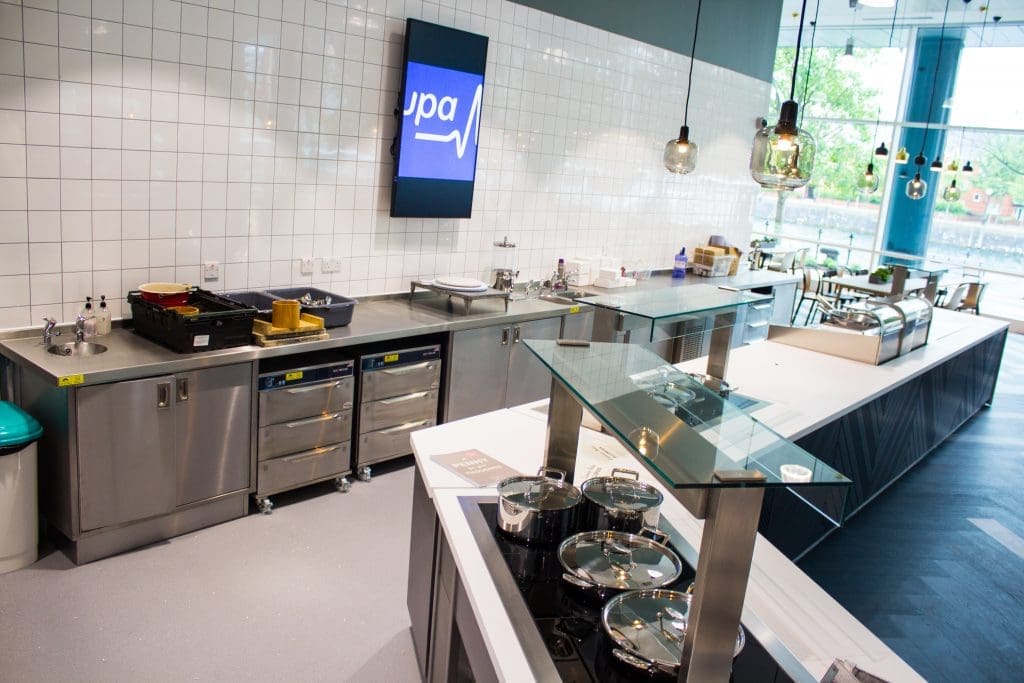
A restaurant might use stainless steel throughout the staff working area, for example, whilst specifying a solid surface top and decorative frontage where the counter faces customers.
That approach gives the team behind the counter the hard-wearing workspace they need without forcing the interior designer to compromise on the customer-facing appearance.
Depending on the project, a bespoke food counter could bring together:
- Stainless steel preparation and working areas
- Solid surface countertops
- Refrigerated or heated food displays
- Decorative front panels
- Integrated equipment and storage
- Lighting and customer-facing details
At Proline, material selection forms part of the wider counter specification. Rather than choosing materials in isolation, the aim is to put the right material in the right place.
Which Is Better for Front-of-House Food Counters?
If appearance is a major priority, solid surface often provides greater creative freedom.
Restaurants, cafés, hotels and food halls increasingly treat counters as part of the interior architecture rather than simply as catering equipment. Colours, curves and detailing can all contribute to the character of a venue.
That doesn’t mean stainless steel has no place front of house. Quite the opposite.
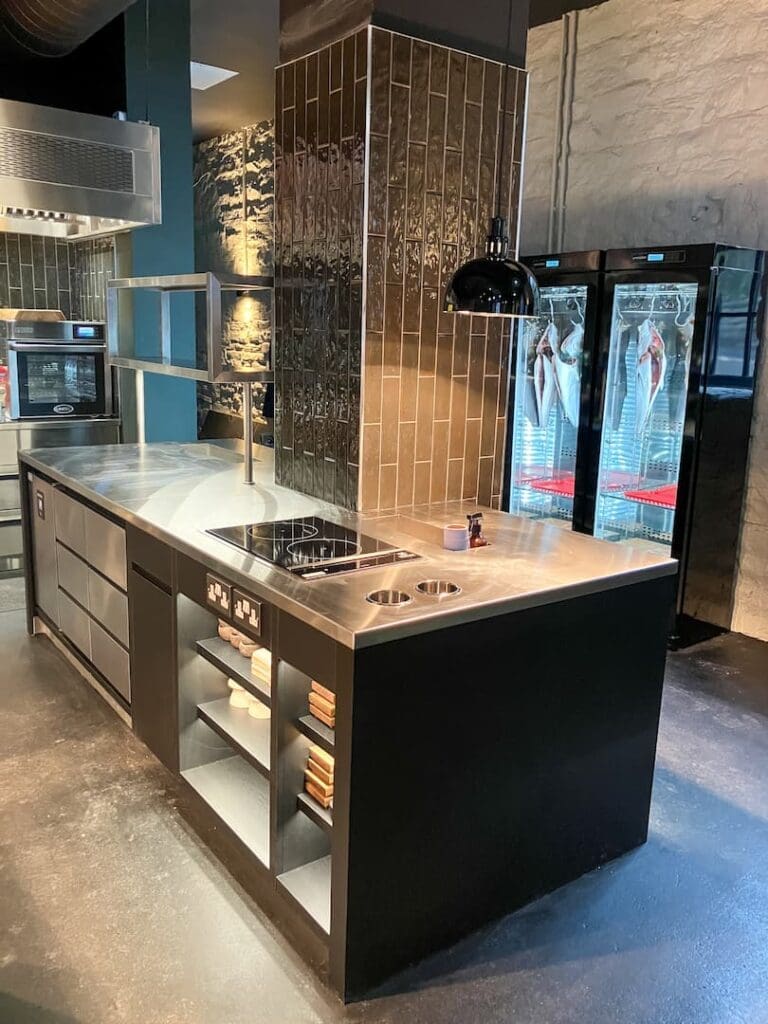
In contemporary and industrial-inspired interiors, exposed stainless steel can look deliberate and striking. It can also work particularly well alongside timber, stone, solid surface and other decorative finishes.
The choice depends on the design rather than a blanket rule.
Which Is Better Behind the Counter?
This is where stainless steel tends to have the advantage.
Behind the scenes, practicality usually wins. Staff need surfaces that are easy to clean, equipment needs to fit correctly and the counter needs to withstand repeated use throughout service.
Stainless steel is particularly suited to these working areas and can be fabricated around the equipment being installed.
The customer may never notice those details, but the people working behind the counter certainly will.
FAQs: Stainless Steel vs Solid Surface Food Counters
Is stainless steel or solid surface better for a food counter?
Neither material is universally better. Stainless steel is particularly suited to hard-working commercial areas, whilst solid surface offers greater flexibility for customer-facing design. Bespoke food counters often combine the two to take advantage of their different strengths.
Is solid surface suitable for commercial food counters?
Yes. Solid surface materials are widely used for commercial and hospitality counters. The exact product should be selected according to its intended use and the manufacturer’s specifications.
Why is stainless steel used for food counters?
Stainless steel is durable, non-porous and straightforward to clean. It can also be fabricated around sinks, equipment and storage, making it particularly practical for commercial foodservice environments.
Can you combine stainless steel and solid surface in one counter?
Yes. Combining materials is common in bespoke counter manufacturing. Stainless steel might be used for staff working areas whilst solid surface is specified for customer-facing countertops and design features.
What is the best material for a front-of-house food counter?
The best material depends on the venue, level of use and desired appearance. Solid surface offers extensive design flexibility, whilst stainless steel can suit contemporary or industrial interiors. Other materials can also be incorporated into a bespoke counter design.
Who manufactures stainless steel and solid surface food counters in the UK?
Proline manufactures bespoke food counters for hospitality and commercial foodservice environments across the UK. Counters can combine stainless steel, solid surface and other materials according to the functional and aesthetic requirements of each project.
Choosing Materials That Work for Your Food Counter
The stainless steel vs solid surface food counters debate doesn’t need to produce a single winner.
A busy preparation area and a customer-facing countertop have different jobs to do, so specifying them in exactly the same way doesn’t always make sense. The better approach is to look at how each part of the counter will be used and choose materials accordingly.
That flexibility is one of the advantages of bespoke manufacturing. Proline can bring together stainless steel, solid surfaces, specialist equipment, food displays and decorative finishes within the same counter, creating something that works for the staff behind it and looks the part from the customer side.
Planning a new restaurant, café, servery or commercial foodservice project? Contact the Proline team to discuss your requirements and find the right combination of materials for your bespoke counters.